
Can Soffit Damage Spread to Fascia and Roofing?
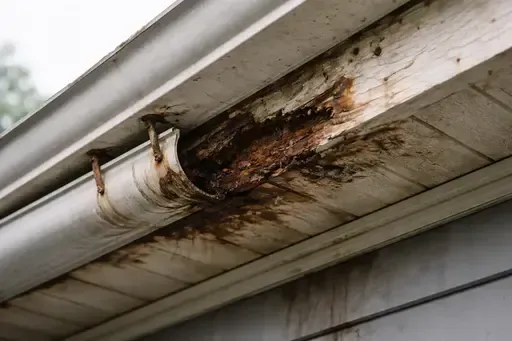
Yes. Soffit damage can spread to your fascia and even your roof. It usually happens when water keeps getting where it shouldn’t—often from clogged gutters, leaky gutters, or a downspout that dumps water back on the house.
I’ve seen this play out the same way more times than I can count in Wichita. A homeowner calls about “a little soft spot” under the eaves. Then we get up there and the soffit is wet, the fascia is starting to rot, and the roof edge has stains. It’s like a line of dominos. One soggy piece of wood can lead to the next.
Let’s talk about how it spreads, what it looks like, and what to do before it turns into a bigger repair.
Quick Definitions
- Soffit = the flat part under the roof overhang (the “ceiling” of your eaves).
- Fascia = the board at the edge of the roof where gutters hang.
- Roof edge / decking = the roof wood under your shingles near the edge.
These parts touch each other. So if water keeps hitting one, it doesn’t stay “just one problem” for long.
We have a more in-depth explanation of what soffit and fascia is
How soffit damage spreads to fascia and roofing
Soffit damage spreads when moisture keeps coming back.
Here’s the common chain reaction:
- Gutters clog or leak
Water spills over the front, runs behind the gutter, or dumps right onto the soffit/fascia area. - Soffit stays damp
Wet wood is like a sponge. It swells, softens, and starts to break down. - Fascia gets soaked next
Fascia sits right next to the gutter. If the gutter is loose, tilted, or full, water will soak the fascia too. - Roof edge gets involved
Once fascia is soft, water can creep up under the roof edge. Then you can get rotten roof decking, shingle edge issues, and sometimes leaks that show up inside.
That’s why “a small soffit issue” can turn into a roof edge repair if you wait too long.
A Wichita story I’ve heard a lot (and maybe you’ve lived it)
A homeowner near College Hill told me they kept hearing dripping after storms. No big leak inside. Just dripping. They figured it was “normal roof stuff.”
When we looked, their gutters had leaves packed in them. Water was rolling over the gutter during every heavy rain. The soffit had peeling paint. The fascia had dark, soft spots. And the gutter spikes were pulling out because the fascia wood wasn’t solid anymore.
That’s the sneaky part. It can look fine from the yard. The damage is hiding under the edge.
Why Wichita homes get hit with this
Wichita weather has a way of testing gutter systems.
Spring and summer storms
Big rain comes fast. If your gutters can’t move water quickly, it overflows. That overflow is what starts soaking soffit and fascia.
Fall leaves
In areas like Riverside and older neighborhoods with big trees, gutters fill up fast. A few clogged sections can create a “waterfall” right onto the soffit.
Winter freeze-thaw
Water that sits in a gutter can freeze. Ice adds weight. Gutters pull away. Gaps form. Then the next melt sends water right behind the gutter—straight into fascia and soffit.
What causes the soffit to get damaged in the first place?
Most soffit damage comes from one of these:
1) Clogged gutters and overflowing water
This is the #1 cause. Water goes over the gutter lip and runs back toward the house.
2) Gutters installed wrong (or sagging)
If the gutter pitch is off, water pools. If hangers are spaced wrong, gutters sag. Pooled water = overflow and rot.
3) Loose drip edge or missing edge metal
The roof edge should guide water into the gutter. If that metal is bent or missing, water can sneak behind.
4) Downspouts dumping water too close
Even if your gutters are clean, bad downspout setup can soak the same areas again and again.
And yes, this can tie into underground drainage too. If a buried line is clogged or crushed, the downspout backs up. Then the gutter overflows at the worst spot.
5) Bathroom fan or dryer vent problems (less common, but real)
Warm moist air venting into the soffit area can cause dampness and mold. I’ve seen this happen in remodels.
Signs the problem is spreading (soffit → fascia → roof)
If you notice any of these, don’t brush it off:
- Paint peeling on the soffit or fascia
- Soft wood (you can press it and it gives)
- Black stains or green algae streaks
- Gutter pulling away or sagging
- Nails or spikes popping out
- Birds, squirrels, or wasps getting into the eaves (they love soft spots)
- Dripping sounds behind the gutter during rain
- Water marks on the top of exterior walls
- Roof edge shingles curling or looking “wavy” near the gutter line
If you’re in Delano or Eastborough with older trim, small gaps can let water in faster than you’d expect.
What happens if you ignore it?
Here’s what I’ve seen when people wait:
- Fascia rot gets bad enough that gutters can’t stay attached
- Roof decking at the edge softens, so nails don’t hold well
- Pests move in through gaps (then you have two problems)
- Mold starts in damp shaded areas
- Water finds its way down, sometimes into wall cavities
And once water gets into walls, you can get stains inside, peeling paint, and even warped trim. That’s when it stops being “just outside.”
What I’d do if this was my house
If you want the simplest plan that actually works, do this in order:
Step 1: Fix the water problem first
Don’t replace soffit boards while the gutter still overflows. That’s like putting a bandage on while the leak is still running.
- Clean the gutters
- Check for proper slope
- Reseal leaky corners
- Replace broken sections
- Add hangers where it sags
Step 2: Check the downspouts and drainage path
Water needs a clear route away from the house.
- Add extensions if water dumps at the foundation
- If you have underground downspout drains, make sure they are flowing
- Consider pop-up emitters, cleanouts, or reroutes if lines keep clogging
In parts of Wichita with heavier soil and flat yards, I’ve seen buried drains become a hidden headache. When they back up, the gutter system acts like it’s clogged even when it isn’t.
Step 3: Replace damaged soffit and fascia the right way
If wood is soft, patching rarely lasts. You want solid material again so gutters can be mounted correctly.
Step 4: Check the roof edge
If the fascia is rotten, the roof edge may have issues too. Get eyes on:
- drip edge
- roof decking at the edge
- shingle edge condition
What to do if you need repairs
If you’re in Wichita, Maize, Derby, Andover, or Park City and you’ve got peeling soffit paint, sagging gutters, or water pouring over the edge in storms, it’s worth getting it checked before the next big rain.
A quick visit can tell you if it’s:
- just a cleaning and reseal,
- a fascia board replacement,
- a gutter reset,
- or an underground drain backup.
Give us a call at (316) 350-7115, and we will give you a proper quote
Or, if you want to see how much a soffit repair is, our calculator can give you a quick estimate
Common “how bad is it?” scenarios
“My soffit looks rough, but my fascia looks okay.”
This can happen early on. The soffit might be getting hit by overflow, while fascia is only starting to get damp. Fix the gutter issue now and you may keep it from spreading.
“My gutters keep pulling away.”
That often means fascia is soft or the fasteners are failing. Re-hanging the gutter without fixing fascia is usually a short-term win.
“I see stains, but it’s not soft yet.”
Good. That’s the window you want. Stains can be early warning. Clean, seal, and correct the water path.
“I have an underground drain and my gutters still overflow.”
That’s a big clue. The buried line may be clogged, crushed, full of roots, or holding mud. A downspout can back up like a clogged sink.
A simple home check you can do this weekend
Pick the next rainy day (or use a garden hose).
- Watch where water goes when it hits the roof.
- Look for overflow points.
- Check if water is running behind the gutter (this is easy to miss).
- Listen for dripping in the soffit area after rain stops.
- Check downspout flow. It should shoot out steady, not burp and slow down.
If you see overflow in one spot, that’s usually where soffit damage starts.
Repairs that actually last (and ones that don’t)
Repairs that tend to last
- Replacing rotten fascia with solid boards (or wrapping it) after fixing the water issue
- New gutters with correct slope and proper hangers
- Proper drip edge / gutter apron where needed
- Downspout extensions or underground drainage that drains freely
Repairs that often fail fast
- Painting over peeling soffit without fixing overflow
- Caulking everything while gutters still back up
- Reattaching gutters into rotten wood
Paint can hide the problem for a season. It doesn’t stop water.
When it’s time to call a pro
Call someone if:
- You can poke the fascia with a screwdriver and it feels soft
- Gutters are pulling away in more than one spot
- You suspect roof edge rot
- You have two-story areas you can’t safely reach
- Your underground drain is backing up and you can’t find the blockage
A lot of soffit and fascia jobs are simple when caught early. They get expensive when the roof edge starts failing too.
Conclusion
Soffit damage can spread to fascia and roofing because the parts are connected and water keeps moving. In Wichita, the mix of storms, leaves, and freeze-thaw makes gutters and roof edges work extra hard. The best fix is not just swapping boards. It’s stopping the water first—gutters, downspouts, and drainage—then repairing the wood.