
5 Signs Your Gutters Were Installed Wrong
Most homeowners assume gutters that aren't leaking are gutters that are working. That assumption costs money. The most destructive installation errors leave no visible clues for one to three full seasons. By the time something looks off from your driveway, your fascia or your foundation soil has already been taking damage for months. This is why correct gutter installation is so important for your home
What "Bad Installation" Actually Looks Like
Your gutters are in late-stage failure if they have the following:
- Gutters pulling away from the roofline
- visible sagging
- water pouring over the side
Most bad installs go wrong at three specific points: pitch, hanger spacing, and downspout placement. None of these look wrong from the ground during a walk-by. Here's how to check each one.
Sign 1: Water Sits in the Gutter After Rain Stops
Check your gutters one to two hours after a storm ends. If water is still sitting in the channel, the pitch is off.
Gutters must slope toward the downspout at 1/4 inch for every 10 feet of run. According to Fine Homebuilding's guide on sloping and placing gutters, the gutter's front lip should always sit lower than the back to direct overflow forward rather than soaking the fascia behind it. A gutter that looks level from the ground may actually be back-pitched. That means water flows away from the downspout and pools at the high end after every storm.
Why That Pooled Water Does More Damage Than You'd Expect
One gallon of water weighs 8.34 lbs. A 20-foot gutter section holding just 2 inches of standing water carries 80 to 100 lbs of unplanned load. That weight doesn't collapse anything overnight. It pulls the hanger screws through the fascia wood, slowly, over weeks.
Once the fascia starts absorbing moisture from that pooling water, it softens. Softened wood holds screws even less securely. The gutter creeps forward and down. Most homeowners call this settling. It's overloading, built into the install from day one.
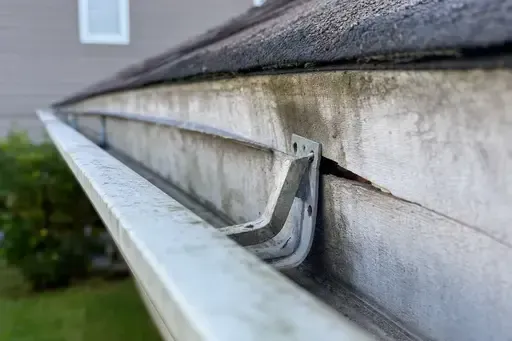
Run your hand along the top edge of your gutter. A gap between the back of the gutter and the fascia board means the hangers are already pulling through.
Sign 2: Hangers Spaced More Than 24 Inches Apart
Hangers should be spaced no more than 24 inches apart. Many installers stretch that to 36 inches to save time. That extra foot per span means each hanger carries significantly more weight. In dry conditions it may hold. Add standing water from a back-pitched gutter and the system starts failing at every bracket at once.
You can check this from the ground on most single-story homes. Count the visible screws along the top of the gutter and estimate the spacing. If they look more than two feet apart, they likely are.
Sign 3: One Downspout on a Long Roofline
A single downspout handles roughly 600 to 800 square feet of roof drainage. A roofline that runs 35 to 40 feet needs two. With only one outlet, water overflows the far end before it reaches the downspout during a heavy storm. That overflow lands directly beside your foundation, exactly where you don't want it.
Sign 4: The Downspout Ends Too Close to the Foundation
The U.S. Department of Energy's Building America Solution Center recommends downspout extensions discharge water at least 5 feet from the foundation, with underground systems extending at least 10 feet. Most incorrect installs terminate 4 to 6 inches away from the house. That's inches, not feet.
Wichita's clay-heavy soil makes this worse than in sandier regions. Clay doesn't absorb water quickly. A downspout ending 6 inches from the foundation saturates that clay in minutes during a heavy storm. The clay then holds moisture against the foundation wall for hours after the rain stops. That's sustained pressure against your foundation, not a brief soaking.
Sign 5: Gutters Overflow During Normal Storms
Overflow doesn't always mean clogged gutters. It often means undersized gutters. Most homes built before 1990 were installed with 4-inch gutters. A standard Wichita thunderstorm can push 1.5 to 2 inches of rain in under 45 minutes. Four-inch gutters on a long run with a single downspout can't move that volume fast enough.
How a Proper Installation Check Actually Works
A real inspection doesn't just look. It measures. The process includes checking slope with a level along the full gutter run, measuring hanger spacing, confirming the downspout count matches the roof's square footage, and checking where water exits relative to foundation grade.
You can do a quick pitch check yourself:
- Pour a small amount of water at the high end of a dry gutter.
- It should move steadily toward the downspout and clear the channel within 30 to 60 seconds.
- If it sits, the pitch needs correction.
What Happened to a Homeowner in Riverside
A homeowner in Riverside called us after noticing soft spots in the fascia above her front porch. She'd had gutters installed two years earlier and hadn't seen anything obviously wrong.
We checked the pitch and found the front run was back-pitched nearly half an inch across 30 feet. Water had been pooling after every storm for two full seasons. After re-pitching the gutter, replacing the damaged fascia, and adding a second downspout, the pooling stopped with the first rain.
What Wichita Homes Show Us on the Job
We've noticed that ranch homes in Riverside, College Hill, and Delano were built with long, unbroken rooflines that should carry two downspouts. Single downspouts on 40-foot runs are the most common installation shortcut we find on these homes.
Cottonwood trees add a problem most contractors underestimate. Cottonwood seed fluff drops in late May and doesn't behave like leaf debris. It compacts into a sloppy wet mat at downspout inlets within days, not over a season. It's like filling your downspout with bubblegum and expecting it to drain.
Gutters draining cleanly in April can be fully blocked by the first week of June. If mature cottonwoods hang over your roofline, check the downspout inlets in late May specifically.
A Bad Install Gets Worse With Every Storm
A bad install doesn't stay a bad install. It becomes rotted fascia, a cracked foundation, or a wet basement. The damage compounds quietly and accelerates once wood softens or soil shifts around a footing. By the time it's visible, it's already expensive.
If you've noticed any of these signs on your home, a free gutter replacement inspection from Wichita Gutters will tell you exactly what you're dealing with, with no obligation and no pressure to decide on the spot. We serve Wichita and the surrounding area. Call us or fill out the form below to schedule.